Joint EWRS working group meeting of the working groups ‘Weed Vegetation and Biodiversity’ and ‘Biological Control’
UPDATE: Extended deadline for registration and abstract submission (ONLY POSTER) until 30th September, 2026 - still 5 places available
Dijon, France, 27th to 29th of October 2026
UPDATE: the maximum number of participants has been reached
Dear Colleagues,
We invite you to the meeting co-organized by the EWRS working groups 'Weed Vegetation and Biodiversity' and ‘Biological Control’.
The meeting will be held from 27 to 29 October 2026 at INRAE Burgundy-Franche-Comté center in Dijon, France. It is locally organized by the Agroecology research unit of the French National Research Institute for Agriculture, Food and Environment.
SCIENTIFIC PROGRAMME
This meeting will be held in the context sustainable weed management. Its aim is to share the latest knowledge on:
- The role of weeds in the provision ecosystem services, for example through their position in food webs
- The diversity of weed communities: its importance in promoting the balance between services and disservices, and its response to management practices
- The use of natural enemies and ecological mechanisms for weed regulation These topics may be addressed in relation to global changes (including climate change).
These topics may be addressed in relation to global changes (including climate change). The meeting aims to bring together scientists from different disciplines: Agroecology, Ecology, Agronomy, Biology, Genetics, etc.
In addition to keynote presentations, the meeting will provide an opportunity to exchange knowledge through oral presentations and posters. Interaction between participants and networking opportunities within the EWRS community will be encouraged during field trips (visit to the CA-SYS platform https://eng-plateforme-casys.hub.inrae.fr/) and a social event organized around the heritage of the Burgundy region.
Venue
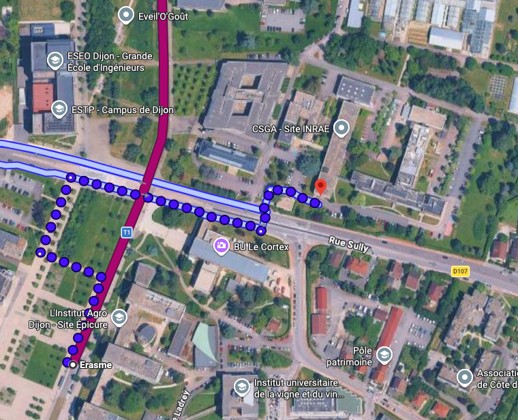
The joint workshop will take place at the INRAE Burgundy-Franche-Comté center in Dijon, France. The address is: 17 Rue Sully, 21000 Dijon. (47.316802982071394, 5.0701175122135025)
It is located next to the tram stop Erasme, on the T1 line, direct from the city center and the train station.
Local Organizing Committee (UMR Agroécologie):
Delphine Moreau (delphine.moreau@inrae.fr), Bruno Chauvel (bruno.chauvel@inrae.fr), & Virginie Nowak
Working group coordinators:
Biological Control: Marion Seier & Philip Weyl
Weed Vegetation and Biodiversity: Alexander Menegat & Michaela Kolářová
Costs:
| EWRS member | Non-member | |
| Regular | 160 | 220 |
| Student (BSc/MSc/PhD) | 130 | 160 |
The difference in fees between members and non-members is the cost of a yearly membership to the EWRS.
The registration fee will cover the costs for the welcome reception, lunches, coffee breaks and the conference dinner. The registration fee won’t cover accommodation and travel expenses.
Travel grants for early career scientists:
To encourage early career scientists to attend the workshop, subsidies are being made available through the EWRS. They can be applied for by sending an e-mail to alexander.menegat@slu.se. Early career scientists (i.e. BSc, MSc and PhD students, and scientists younger than 35 years of age) can receive a refund that will cover part of their accommodation and travel expenses. The maximum amount of the refund will be based on the number of applicants but cannot exceed €600. If the applicant is not an EWRS-member, an amount equal to the yearly EWRS fee (€30 for students and €60 for regular members) will be deducted from the subsidy, and the applicant will be enrolled in EWRS.
The maximum number of subsidies to be awarded to one early career scientist is three in total. Applications will be evaluated by the Working Group Leaders (Alexander Menegat, Michaela Kolářová, Marion Seier, Philip Weyl) and the Scientific Secretary of the EWRS, Lynn Tatnell.
Applications need to include:
- A short motivation letter
- A curriculum vitae
- An estimate of the costs for travel and accommodation
- A statement from the home institute that they will cover the remainder of the expenses for travel and accommodation, should the travel grant be awarded.
Registration and deadlines:
Registration and abstract submission will be opened from July 1st, 2026 until August 15th.
UPDATE: The deadline for registration and abstract submission (only posters) has been extended until 30th September, 2026.
The maximum number of participants is 40.
DOWNLOAD here the FIRST CIRCULAR.